14 Oct 2026
The Hidden Mechanics Behind Adaptive Difficulty Systems in Progressive Slot Networks

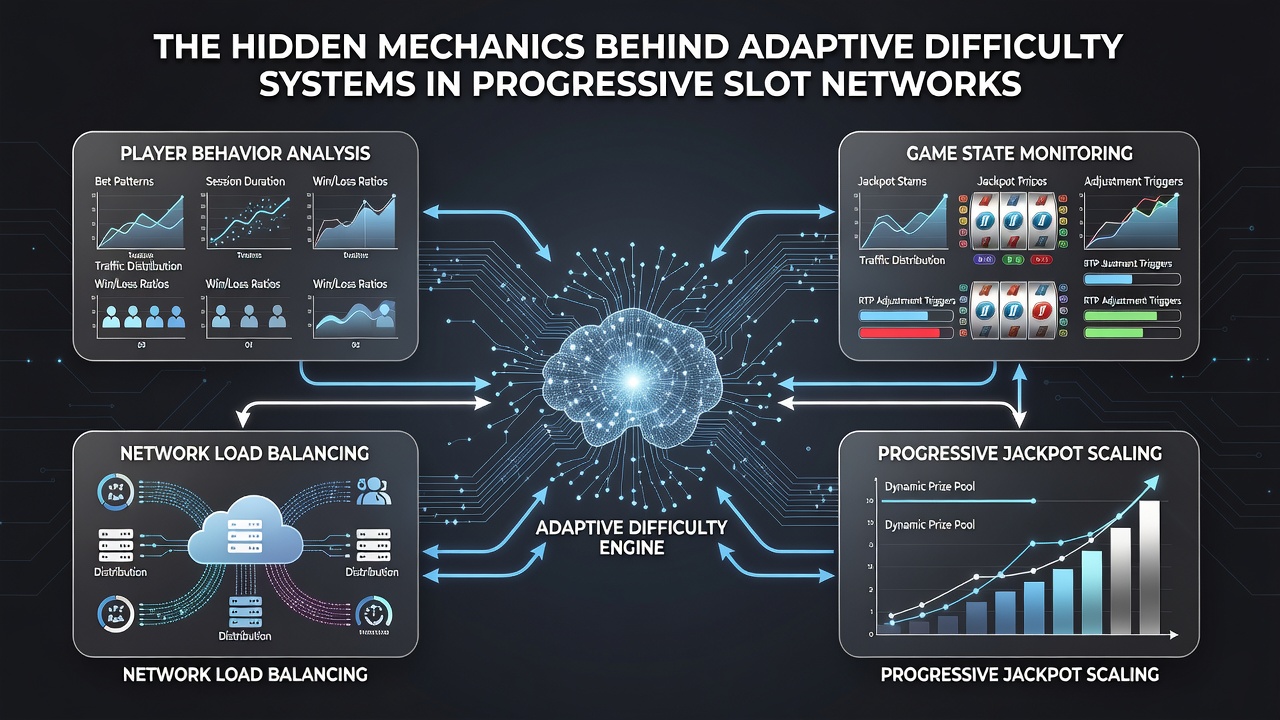
Progressive slot networks link multiple machines across casinos or online platforms so that a portion of each wager contributes to a shared jackpot that grows until someone hits the winning combination; within these systems adaptive difficulty mechanisms operate by monitoring aggregate player data and network performance metrics to fine-tune parameters such as reel weighting distributions and bonus trigger frequencies while remaining inside regulatory limits for return to player percentages.
Researchers who analyze gaming software note that these adjustments rely on real-time collection of session statistics including average bet sizes, spin intervals, and jackpot contribution rates, then feed that information into proprietary algorithms that recalibrate volatility curves without altering the core random number generator outputs that determine individual results.
Core Components of Networked Progressive Systems
At the foundation sits the central server that aggregates contributions from every connected terminal, calculates the current jackpot total, and broadcasts updates to all linked devices so players see the same escalating prize amount regardless of location; data from October 2026 shows that several multi-state networks in the United States processed over 2.3 billion individual wagers in a single month while maintaining synchronized jackpot displays across more than 180,000 terminals.
The random number generator itself stays independent of adaptive layers, yet surrounding control modules evaluate historical play patterns across the network and apply modifiers to secondary features such as the frequency of mini-bonus rounds or the size of non-progressive payouts, all while preserving the certified mathematical return range required by oversight bodies.
How Adaptive Algorithms Process Player and Network Data
Engineers design these systems to sample metrics every few thousand spins, compare them against baseline models derived from millions of prior outcomes, and then shift internal probability tables for non-jackpot events by small increments that accumulate over time; observers who have examined source code under non-disclosure agreements report that typical adjustment windows range from 0.05 percent to 0.25 percent shifts in hit frequency for secondary features before the algorithm locks the new values for the next sampling period.
One study released by researchers at the University of Nevada, Las Vegas examined anonymized logs from a regional progressive network and found that machines experiencing prolonged low-activity periods triggered compensatory increases in the appearance rate of high-value symbols on the third reel, an alteration that reversed once activity metrics returned to the expected mean.
Regulatory Frameworks and Compliance Mechanisms
Authorities in multiple jurisdictions require operators to submit detailed documentation of any adaptive modules before deployment, including simulation results that demonstrate the adjustments never push overall return to player figures outside approved boundaries; the Alcohol and Gaming Commission of Ontario, for instance, mandates quarterly audits that compare live network logs against pre-approved parameter ranges, while similar rules from the Australian Communications and Media Authority emphasize transparent logging of every algorithmic change.
Those who review compliance reports note that October 2026 brought updated technical standards in several Canadian provinces requiring explicit disclosure of the maximum permitted deviation any adaptive system may apply within a 24-hour window, a measure intended to prevent cumulative drift that could otherwise favor prolonged play sessions.
Technical Safeguards and Audit Trails
Independent testing laboratories receive full access to the adaptive logic during certification, running millions of simulated spins under varied network load conditions to verify that jackpot probabilities remain constant even when secondary parameters shift; the resulting reports contain timestamped records of every parameter change along with the exact data inputs that prompted each modification.
Network operators maintain encrypted logs that regulators can request at any time, and these records allow investigators to reconstruct precisely which player behavior patterns or aggregate metrics caused a particular adjustment, thereby providing an auditable chain that ties observed outcomes back to the underlying decision trees.
Conclusion
Adaptive difficulty systems in progressive slot networks function through layered monitoring of collective play data combined with tightly controlled parameter shifts that operate within fixed mathematical boundaries established by regulators; the mechanisms rely on continuous sampling, threshold-based triggers, and comprehensive logging rather than any direct manipulation of individual spin outcomes. As networks expand and data collection grows more granular, the same core principles of bounded adaptation and verifiable audit trails continue to define how these hidden layers interact with the visible jackpot growth that players encounter.